Word Scramble: The Letter Pairs That Win Rounds
Sixty seconds is not enough time to read nine letters one at a time. It is plenty of time to scan for five patterns.
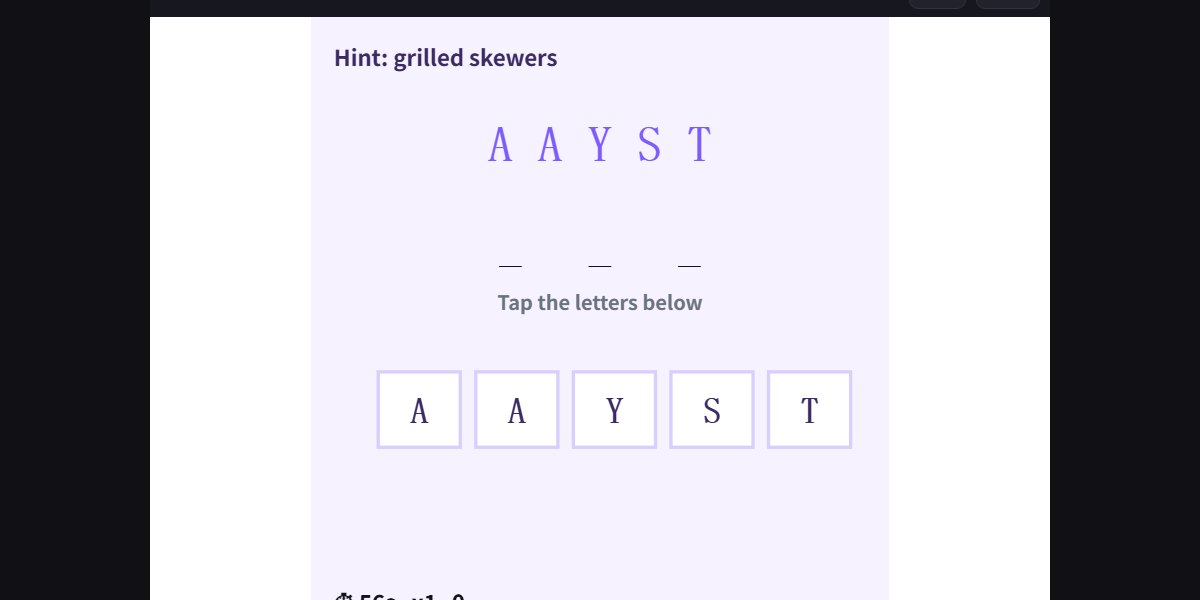
Word Scramble rewards recognition, not vocabulary. The players with the highest scores are rarely the ones with the biggest word list; they are the ones who look at a rack of letters and see patterns instead of characters.
Scan for digraphs first
English is built on a small set of letter pairs that appear constantly: th, he, in, er, an, re, on, at, en, nd, ti, es, or, te, of, ed, is, it, al, ar. Before you read a single letter, look for any of these. A rack containing “t” and “h” almost always has at least one word starting with th.
Look for the -ing and -ed tails
If your rack contains an “i”, an “n” and a “g”, there is very likely a gerund hiding in it, and gerunds are long words. The same is true of the -ed, -er and -ly endings. Tails are the highest-value pattern in the game because they turn a five-letter word into a seven.
Play the short word immediately
The streak multiplier is worth more than any single long word. A three-letter word found in second one keeps the multiplier alive and pays for itself; the same word found in second forty is worth nothing because the streak has already reset. When in doubt, type the safe word first and hunt afterwards.
Save the all-letters answer
Almost every rack has a solution that uses every letter, and it is worth several times a normal word. Do not burn the clock hunting it at second zero. Play two or three quick words to build the streak, then commit to the full-length hunt with twenty seconds left.
Do not restart for easier letters
Every rack is randomised with the same distribution. Restarting does not find you better letters; it just costs you a round. The only racks that are genuinely harder are the ones with four vowels, and even those almost always hide a long word.